
You can’t stop scrolling because you’re in pain
While glued to the phone, where do your thoughts go?

Back in January, I made a resolution that this would be the year I relearn how to sit with things. Books, movies, TV shows, my own damn thoughts. To do that, I needed to curb my social media use. Short-form video was a big part of my media consumption, so cutting back on scrolling became job one.
For a while, it worked. I stopped posting on Instagram and reaching for TikTok at the first sign of discomfort. I stared at the ceiling or out the window. Got bored. Let my thoughts haunt me.
It was distressing. Feelings I buried a long time ago popped up again. I forced myself to pay attention. Some days I journaled twice, unable to keep up with the flood of unprocessed emotions. While I was still picking up my phone often, I trained myself to put it back down. The recalibration was annoyingly slow, but I was making progress.
It lasted for about three weeks.
In early February, I was back to two hours of mindless scrolling per day. I told myself it’s just a relapse, I’ll be fine. After all, I was still reading, still thinking, no longer opening TikTok at 3 am.
Unfortunately, dog’s health worsened. In March, we said goodbye. I didn’t want to handle the grief all at once.
I scrolled some more.
*
I knew on an intellectual level that mindless scrolling is a coping mechanism. An avoidance technique. You don’t want to deal with your current reality, so you pick up your phone, open a social media app, and overload your brain with useless nonsense, hoping it will forget what was bothering you in the first place. Maybe even churn out some dopamine.
What took me longer to understand was that the things bothering me didn’t magically disappear. Rather than being at peace, I was distracted. Once I allowed my brain space to just be, everything resurfaced with a vengeance. If you’ve been numb for a long time, waking up can feel like a dozen pigeons simultaneously pecking at you. The crazy thing is that you have to resist putting up a fight.
*
I’m no stranger to coping mechanisms. I’ve used plenty before, not all of them destructive. Reading at least isn’t harmful. 2020 was the only year when I read 100 books, and it included the two months at the beginning of the pandemic when I could read nothing. Turns out, there’s a fine line between reading for entertainment/learning and reading to hide away from the real world. By the end, at least my attention span was better. Similarly, binge-watching TV shows for hours at a time during my 20s set the foundation for learning how to assess media through a critical lens.
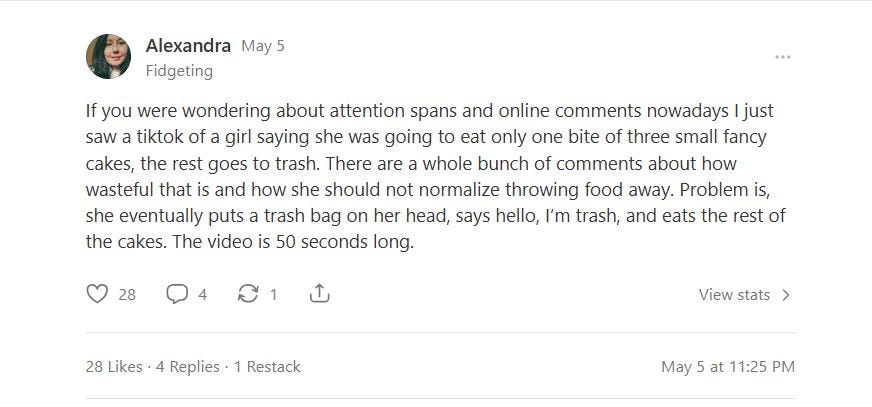
Mindless scrolling, however, comes with long-term negative repercussions. Those include our dwindling ability to focus. I can’t stop thinking about this TikTok from the other day:
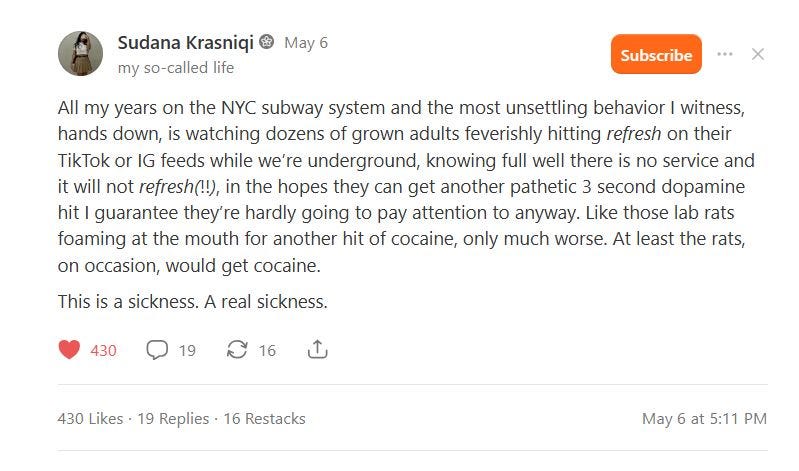
This recent Note from Sudana is also sobering:
I see more and more people glued to their phones. On public transport. While standing in line at the supermarket. Even had to avoid bumping into others while walking on the street because they were staring down at a screen.
The sad thing is that we’re aware of what this mindless scrolling is doing to us. There’s the popular “when you forget your headphones at home and have to be alone with your thoughts” trend. The analog resurgence proves we’re burnt out from information overload. Tips on how to be less online are everywhere.
What I couldn’t find many people talking about was whether they’ve experienced the same flood of buried thoughts and emotions once their screen time was down. Not dealing with them is a surefire way to go back to your bad habits.
*
I started writing this post weeks ago, yet I was wary to press publish. I don’t have a neat conclusion or a magical solution for how to disconnect. Would like to say I’m doing better now, but that would be a lie. I stay up scrolling until late at night, my sleep is chaotic, my anxiety is worse.
I’m still searching for that elusive balance between staying informed/up-to-date on pop culture and ruining my eyesight with videos I don’t care about. I also don’t know how to promote my writing without being online.
I picked up Wuthering Heights recently. My copy is 280-something pages. A breeze, I told myself. It’s been almost two weeks, and I’m on page 80. When Joseph speaks in dialect, I reach for my phone to find a modern translation because my brain can’t comprehend what he’s saying. There are words I have to look up. Each time I do, I instinctively scroll to a social media app, which takes me out of the book, sometimes for good.
I miss posting on Instagram. After a four-month break, I uploaded a bunch of stories, and it was nice to see people interact with them. While I kept up with my online friends there and hearted their content, they had nothing of mine they could heart for a bit. That made me feel lonelier. Typing this paragraph was embarrassing, and now I feel lame.
The kicker is that I don’t even find joy in short-form videos anymore. I joined TikTok to watch cleaning content, which is relaxing to me, yet I can’t remember the last time the algorithm showed me a Sunday reset. I don’t know if the quality of the content went down, the algorithm got worse, or I just consumed all the original ideas on the platform, so I’m left solely with rage bait and half-baked thoughts.
I also can’t tell for sure whether more creators are relying on AI to write their scripts, but I often watch a promising video only to realize it says nothing of substance. A girl rambles for 6 minutes on how to “get everything you want,” and the whole thing boils down to “be more confident.” I watch the video, baffled, then scroll through hundreds of comments praising it, my brain cracking further with each sentence.
Are these bots? Or are they actual, real people who can no longer distinguish between valuable information and garbage?
*
I haven’t read Walden, but Thoreau has a quote that is always in the back of my mind. “The mass of men lead lives of quiet desperation.”
It’s probably still true. The difference is that, now, said desperation can be buried under layers of GRWMs, #storytimes, memes, hot takes, brain rot, trends, fake outrage, and AI slop. If you forget it’s there, you’re less likely to do something to change your circumstances.
All the while, inhaling someone else’s thoughts and outfits and lives on repeat actively dims your originality. Are you still you? Or have you become a less authentic version of yourself, content to borrow someone else’s opinion instead of forming your own?
It’s hard to stop scrolling when you’re in pain. If you pull it off, it’s even harder not to go back. You need to learn how to live with yourself again.
Once that’s done, though, you get your quiet back.
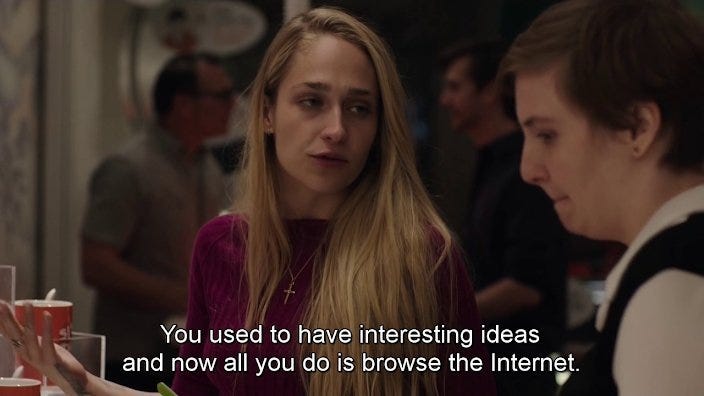
At least I hope so, because I’m giving it another shot. That photo of Jessa is now on the same phone screen as my social media apps.
She was ahead of her time.
My content is currently free, but you can support my work via Ko-Fi or Revolut. Fuel my delusion that I can make a living by writing a blog.
Nothing at all embarrassing about that paragraph you thought was embarrassing. This is who we are these days, what can we do? That's not a rhetorical question, btw, we can do plenty, but don't beat yourself too much about it (easy for others to say).
I'm much less online (especially outside of Substack, which I swear takes up 98% of my online social media time) but even I struggle with attention spans and books. My issue is that even when I think I'm immersed in a book, my mind is racing and thoughts keep popping into my head, and that often means a strong urge to immediately google something before I forget and if I resist that urge and continue reading, later on I'm annoyed with myself for forgetting whatever it was that popped into my head (which was almost certainly not that important).
A few weeks ago I banned myself from any social media but Substack until I finish the big draft I was struggling with. I find for a social media ban to work, I have to set myself that kind of boundary. It has got to be cold turkey for me. I think it's been almost four weeks now. I don't miss it at all, and I have never been as successful as this time in keeping my target goal on track.
I just love this piece, Alexandra! Thanks for sharing!